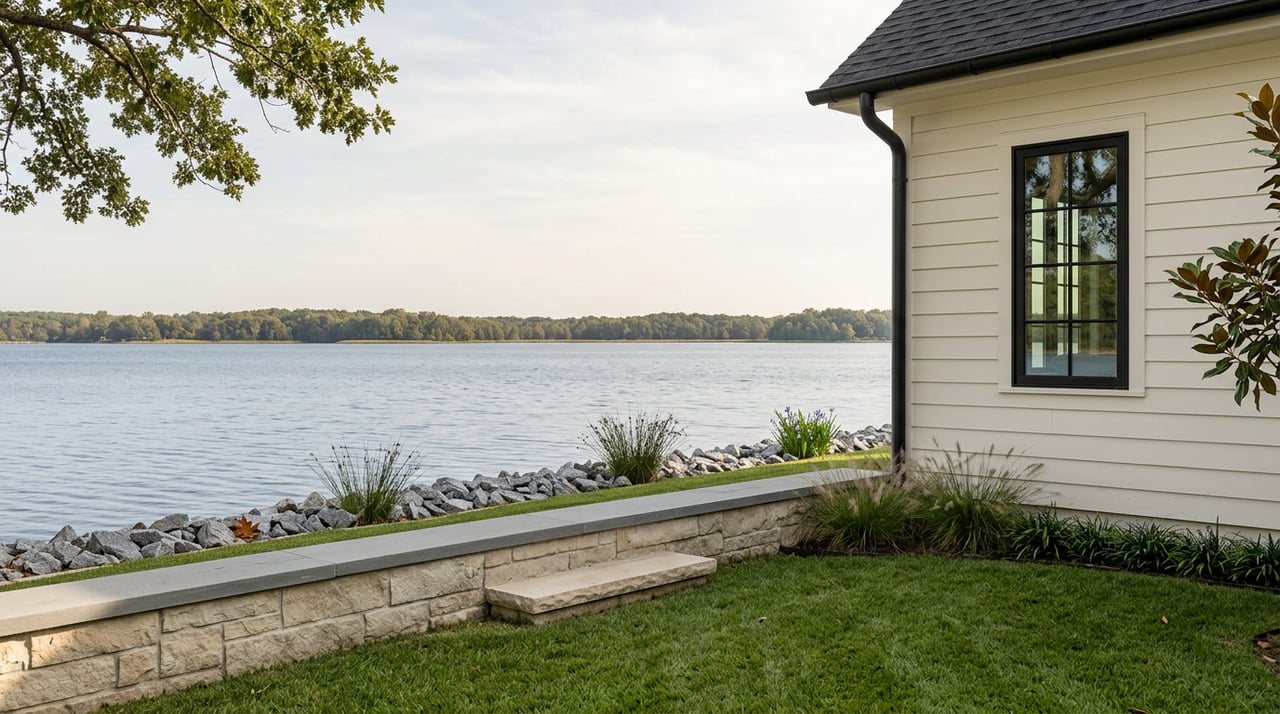
Two listings sit next to each other on the map. Both call themselves waterfront. Both are on Lake Murray. One is asking in the low $500s. The other is asking $1.2 million. The square footage is close. The finishes are close. The lot sizes are within a few thousand feet of each other. A buyer flipping between the two tabs is left to assume the higher price is paying for a view, a kitchen, or a broker's optimism.
It usually isn't. The price gap on Lake Murray is almost never about the house. It is about a single line on a survey, and about which side of a Dominion Energy eligibility threshold the lot falls on. Once you learn to read that line, the portal median stops being useful and starts being misleading.
The line that splits the market at 100 feet
Every dock, boat lift, seawall, and rip-rap section on the lake is permitted by Dominion Energy under the Saluda Hydro Project's federal license, and the permits reference a specific elevation called the 360-foot contour. Dominion's Shoreline Management Plan sets the eligibility rules, and the rule that quietly sorts the market is this: an individual residential dock generally requires at least 100 feet of frontage measured along the 360' contour, and a slip dock requires 200 feet. Lots below that width fall into a different economic class, one where the buyer's realistic options are a shared dock built with an adjacent owner or, for lots platted before 1989 next to an existing permitted dock, a limited-size grandfathered structure.
The eligibility rules travel with the parcel, not the seller. That is why two side-by-side lots can price so differently. One qualifies for a private, permitted dock with a covered slip. The next one over does not, and never will unless its neighbor cooperates on a shared structure that requires each lot to contribute at least 50 feet along the 360' line.
A few other Dominion parameters compress the design envelope once eligibility is settled:
- Private docks are commonly capped near 750 square feet total and about 75 feet in length.
- Setbacks from neighboring property lines are typically about 15 feet.
- A dock generally cannot extend more than roughly one third of the width of a cove or channel.
- Maximum permanent boat length on an individual residential dock is often cited near 34 feet, which quietly rules out larger cruisers on tight coves.
None of that shows up on a listing photo. All of it shows up in the appraisal.
Why the July 2026 medians hide more than they reveal
Redfin's July 2026 numbers put the Chapin-side Lake Murray median sale price at $449,000, down 2.4% year over year, at about $188 per square foot with a 63-day median time to sale. The Richland-side median came in at $496,000, down 3.4% year over year, at $166 per square foot and 82 days. Read cold, those figures suggest a soft, roughly $450K to $500K lake.
Read against the dock eligibility rule, they describe something different. The bulk of transactions inside those medians are off-water homes with lake access, cove-facing lots with limited or shared-dock eligibility, and older homes on narrower pre-1989 frontage. The deep-water Lexington-side inventory sits well above those medians, with closings clustering near $1.18 million in Q2 2026, and Chapin-side three-bedroom waterfront homes closing near $825,000 in the same window. Supply lake-wide is running around 2.5 months, and the properties that check the frontage, depth, and cove-position boxes are moving in under 30 days.
The takeaway is not that the median is wrong. It is that the median averages across two economically separate products. Sorting by list price alone does not separate them. Sorting by frontage at the 360' contour does.
The four inputs that actually price a Lake Murray lot
When a listing crosses your inbox, four questions do more to explain the price than any square-footage comp. Ask them in order.
Frontage at the 360' contour. Is the lot at or above 100 feet, meaning it qualifies on its own for an individual dock? Is it between 50 and 100 feet with a pre-1989 plat and an existing permitted neighbor dock, meaning limited-size options are on the table? Or is it under 50 feet with no path to a private permit? Each answer moves the value by a large step, not a small one.
Water depth at the dock line. Depth is measured against pool levels that swing by design. Full pool is 360 feet, summer normal runs closer to 358, winter sits around 355, and Dominion draws down to 350 every three to five years for aquatic vegetation control and shoreline work. A dock that floats a 28-foot boat in June may be sitting in mud during a February drawdown. Buyers pay a premium for depth that survives the drawdown, and the premium is one of the reasons deep-water Lexington-side lots close near $1.18 million while similar-sized homes on shallower cove backs close far lower.
Main-lake versus cove position. Main-lake frontage buys open sightlines, west-facing sunset exposure on the Lexington shore, and enough width for the dock-length and one-third-of-channel rules to be non-binding. Cove position buys quieter water, less wake, and, on the Chapin side, easier access to Dreher Island State Park's shoreline. Neither is objectively better. They price differently because they solve different problems, and the buyers who confuse the two overpay in both directions.
Dock permit condition and match. Every permitted dock has a number, a decal, and a filed configuration. If the dock on the water does not match the configuration on file, closing can slow down, an attorney can flag the discrepancy, and a buyer's inspection can turn into a price negotiation. This is a diligence item, not a deal-killer, but it belongs in the pricing conversation before an offer.
Named sub-markets sort predictably against those four inputs. Timberlake Plantation in Chapin, Windermere and Night Harbor in Lexington, and Harbourwatch in Irmo are the addresses currently drawing the most serious buyer activity, with Paradise Cove and Plantation Pointe active at the amenity-community tier, and Whitewater Landing pulling attention on the new-construction side. Off-water, ZIP codes 29036 and 29063 continue to price against relocator demand rather than lake demand.
Timing the tour, not just the offer
The most consequential Lake Murray shopping window runs April through July, and homes listed inside that window have historically sold for roughly 2% to 4% more than comparable homes listed in the fall. Buyers who wait until August compete with families trying to close before school starts, into thinner inventory. That much is conventional.
The unconventional piece is the drawdown calendar. The three-to-five-year cycle to 350 feet is the only time a buyer can actually see the seawall, the dock pilings, and the lakebed slope in front of the property. Touring during a drawdown is worth more than touring during peak pool. If your search window overlaps one, use it. If it does not, ask for photos from the last drawdown before you write the offer, and add a dock and shoreline inspection to the standard home inspection.
South Carolina's boating rules also shape the value of a specific dock more than most buyers realize. State law requires most boats to keep at least 100 feet from docks on major reservoirs and prohibits wake surfing within 200 feet of a dock, person, or moored vessel. On a narrow cove, those distances change what the water in front of the property is actually usable for.
A short FAQ
Can a lot with under 100 feet of frontage ever get a private dock? Sometimes, if it was platted before 1989 and the adjacent lots already have permitted docks, Dominion may consider a limited-size individual permit. Final eligibility is Dominion's call, and it is worth confirming in writing before an offer, not after.
Does the dock permit transfer to me at closing? The permit is tied to the property, so it moves with the parcel. What you inherit is the exact configuration on file. Any additions or modifications made by prior owners that are not on the permit are yours to reconcile.
Why do Lexington-side lots command such a premium? Deep water at the dock line, main-lake orientation, west-facing sunset exposure, and proximity to Lexington's Highway 378 corridor stack in one place. The closings near $1.18 million reflect all four inputs lining up on the same parcel, not a per-square-foot valuation.
The portal median tells you what an average Lake Murray transaction looked like last month. It does not tell you which product you are buying. The frontage line, the depth, the cove position, and the permit are what price the property. If you would like a read on a specific listing against those four inputs, or an honest valuation of a lake home you already own, The SC Key Group can walk you through the numbers before you write anything down.